In this article
What Is the 7-Minute Rule?
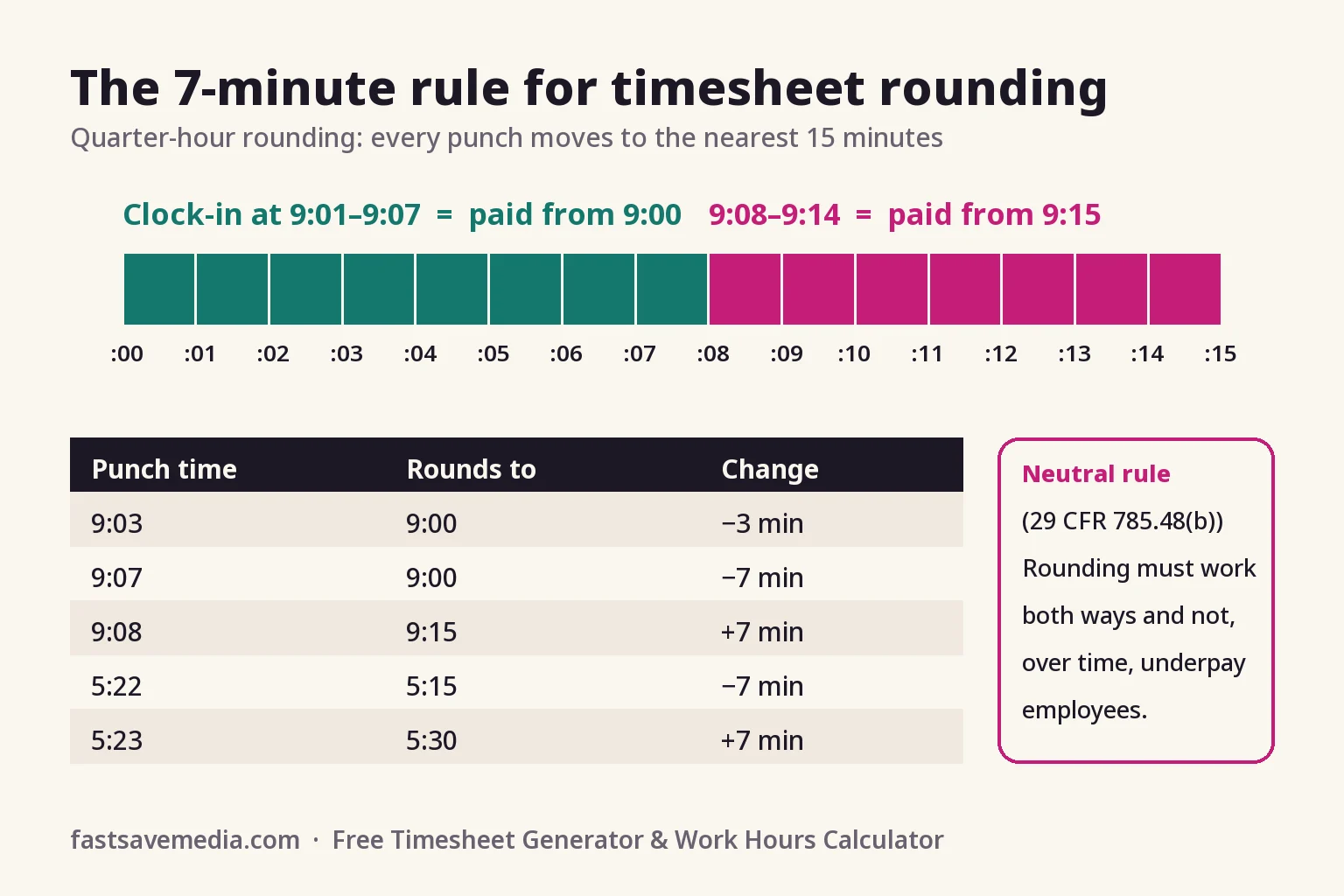
The 7-minute rule is the common name for quarter-hour rounding of time clock punches. Each punch is moved to the nearest 15-minute mark: if it is 1 to 7 minutes past a quarter hour, it rounds down; if it is 8 to 14 minutes past, it rounds up to the next quarter hour. A clock-in at 9:07 is recorded as 9:00, while a clock-in at 9:08 is recorded as 9:15.
In the United States the practice comes from the Department of Labor regulation 29 CFR 785.48(b), which allows employers to round starting and stopping times to the nearest 5 minutes, tenth of an hour or quarter hour, as long as the method is used in a way that does not underpay employees over time.
15-Minute Rounding Chart
The same window repeats every quarter hour. Use this chart to check any punch:
| Minutes past the hour | Rounds to |
|---|---|
| :00 – :07 | :00 |
| :08 – :22 | :15 |
| :23 – :37 | :30 |
| :38 – :52 | :45 |
| :53 – :59 | next :00 |
Because the rule moves a punch by at most 7 minutes either way, the largest difference on a single punch is 7 minutes, or about 0.12 decimal hours.
The Neutrality Requirement
Rounding is only lawful under federal rules when it is neutral. That means it must round both up and down, and over a period of time it must average out so employees are paid for all the time they actually worked. A policy that only ever rounds in the employer's favour, for example rounding late clock-ins up but early clock-ins never, is the kind of practice the regulation does not allow.
Neutrality is judged on real results, not just on the written policy. If staff routinely clock in early and out late, a "neutral" rule can still shave minutes off every shift. Some employers review rounded and exact totals side by side to show that the policy evens out.
Worked Example: Exact Minutes vs 7-Minute Rounding
Here is one five-day week for an employee who takes a 30-minute unpaid lunch each day:
| Day | Actual punches | Exact hours | Rounded punches | Rounded hours |
|---|---|---|---|---|
| Mon | 8:53 – 5:06 | 7.72 | 9:00 – 5:00 | 7.50 |
| Tue | 9:08 – 5:22 | 7.73 | 9:15 – 5:15 | 7.50 |
| Wed | 9:04 – 5:31 | 7.95 | 9:00 – 5:30 | 8.00 |
| Thu | 8:59 – 5:09 | 7.67 | 9:00 – 5:15 | 7.75 |
| Fri | 9:02 – 5:00 | 7.47 | 9:00 – 5:00 | 7.50 |
| Total | 38.53 | 38.25 |
Exact minutes total 38.53 hours; the rounded sheet totals 38.25 hours, about 17 minutes less in this week. One week does not prove a policy is unfair, but if the gap points the same way week after week, the rounding is not neutral. Tracking exact minutes avoids the question entirely.
State Rules and Meal Breaks
Federal rules set the minimum. Some states are stricter. In California, for example, the state Supreme Court held in Donohue v. AMN Services (2021) that employers may not round meal-period punches. If you run payroll in more than one state, check each state's labour department guidance before adopting a rounding policy, and treat this guide as general information rather than legal advice.
Should You Round or Track Exact Minutes?
- Exact minutes are simplest to defend: what was worked is what is paid. Modern digital timesheets make this easy.
- Rounding can still make sense with older punch clocks, as long as it is applied the same way to everyone and reviewed for neutrality.
- Whichever you choose, convert minutes to decimal hours by dividing by 60 (15 minutes = 0.25, 45 minutes = 0.75) before multiplying by the hourly rate.
Free Tools to Calculate Your Week
Enter exact start, end and break times in the Weekly Timesheet Generator to total regular and overtime hours and print or download the sheet. To check a single day or compare two shifts, use the Work Hours Calculator, and see Overtime Pay Calculator for time-and-a-half pay. For the full method behind payroll hour maths, read How to Calculate Work Hours for Payroll Timesheets.
Frequently asked questions
Is the 7-minute rule legal?
Does 8 minutes round up to 15?
Can an employer round only in its own favour?
How do I convert rounded time to decimal hours?
Nayeem — Software Developer of fastsavemedia.com
Built FastSaveMedia to provide free, privacy-first web utilities and browser tools running entirely in modern web browsers without server uploads. Passionate about web performance, audio signal processing, and accessible digital tools.
LinkedIn profile